

The Edge Malaysia reported in its 29 March 2021 issue that fewer companies were wound up in 2020 compared with 2019. The article shared two interesting statistics they obtained from the Companies Commission of Malaysia.
First, the decreasing number of winding up of companies and limited liability partnerships (LLPs) between 2019 and 2020.
2019 had 5,653 winding up of companies and LLPs. In 2020, that figure dropped to just above half of that – 3,294.

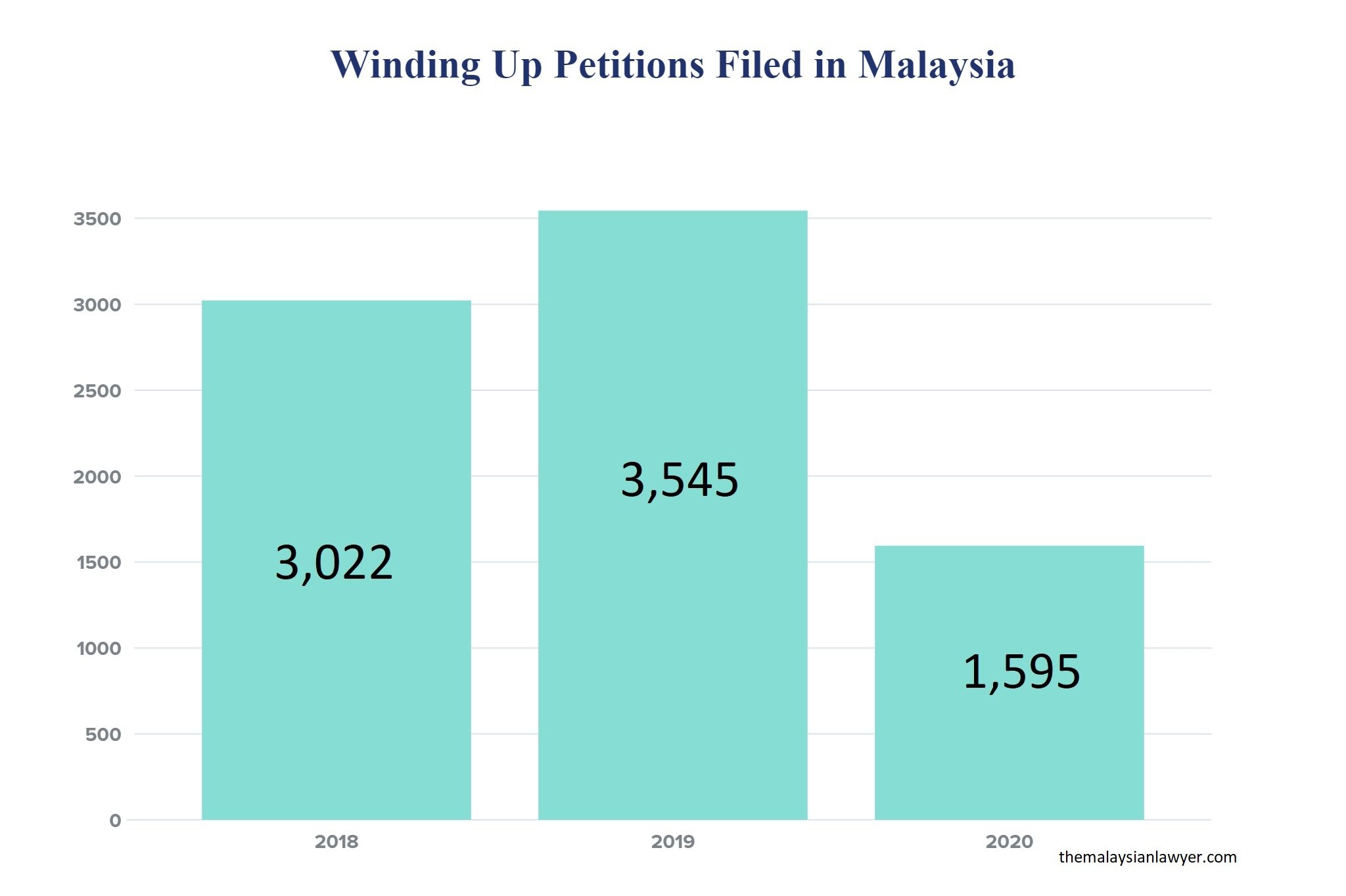
Second, a drop in the number of winding up petitions filed in 2020. 2018 and 2019 saw an upward trajectory at 3,022 and 3,545 petitions respectively. In 2020, that dropped to less than half to 1,595 petitions.
My Observations
First, there was economic turmoil in 2020 due to COVID and the movement controls. But I am not surprised to see the drop in the number of winding up of companies and the drop in the number of winding up petitions being filed.
Two winding up reliefs were in force from 23 April 2020 and lasted until 31 December 2020. There was an increase to the winding up threshold from RM10,000 to RM50,000, and where the statutory demand period was increased to six months.
These reliefs would have greatly discouraged the filing of winding up petitions and obtaining court orders for winding up.
Second, there may have been some small relief due to Malaysia’s COVID-19 Act. But that only came into force on 23 October 2020. I think it would have had a negligible effect in providing relief against winding up.
Third, in terms of moving ahead, the Prime Minister in his PEMERKASA speech on 17 March 2021 has mentioned that the statutory demand threshold will be permanently kept at RM50,000.00 (see paragraph 39 of the speech).
Fourth, the forced reduction of winding up cases is not necessarily a good thing. The number of winding up matters was already on the upward trend. The economic shock in 2020 would have ordinarily resulted in a much higher number of cases. The companies without a viable business model would have been wound up. The winding up process would have prevented the companies from continuing to trade on an insolvent basis. Would have prevented the companies from taking on more unsustainable debt.
Fifth, the key winding up relief was the extended six-month statutory demand period. That would have dissuaded creditors from filing the winding up petition. With that relief now having lapsed, we should expect the 2021 number for winding up to climb dramatically.