
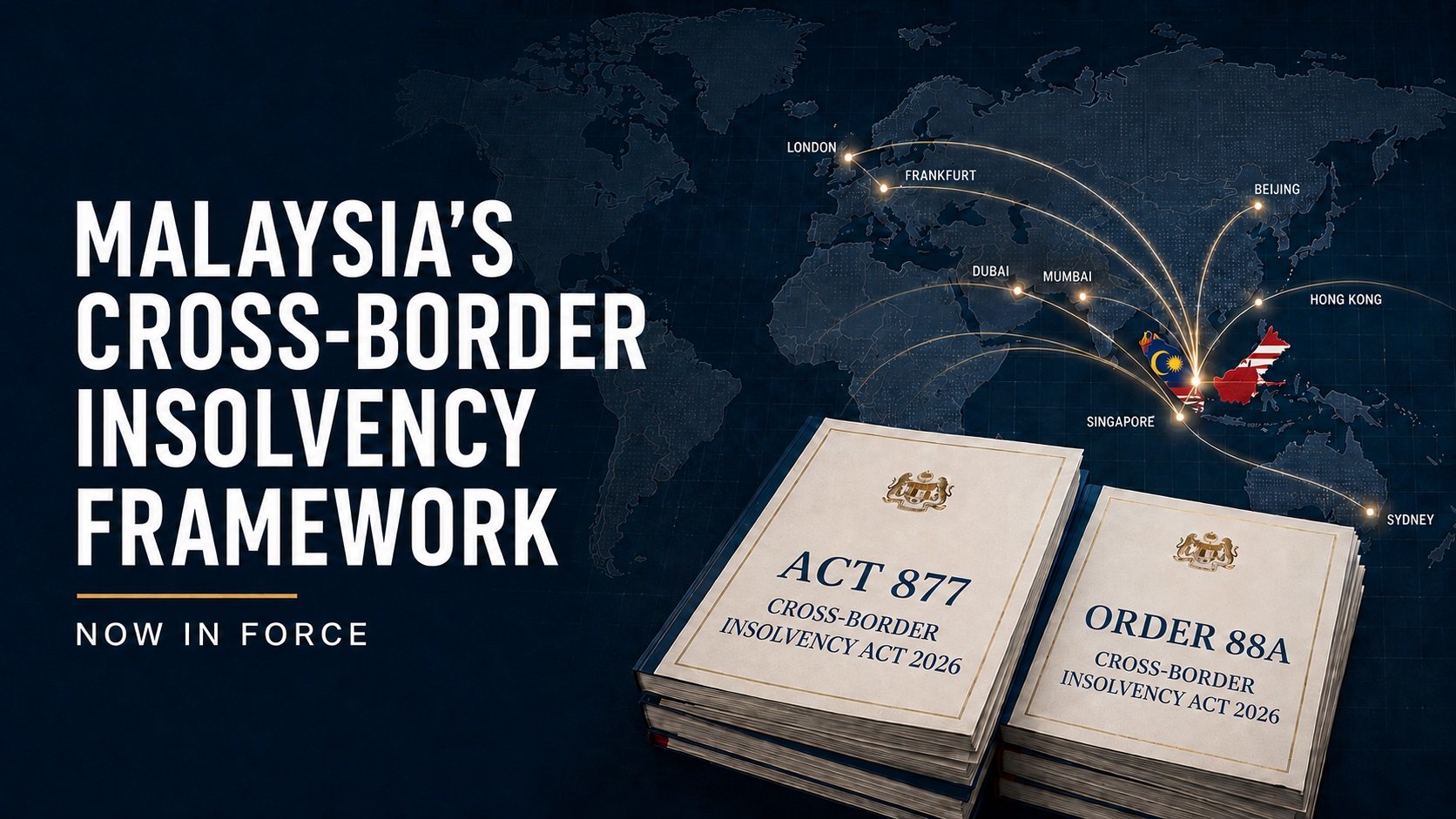
The Model Law on Cross-Border Insolvency has firmly landed in Malaysia.
On 28 August 2026, the Cross-Border Insolvency Act 2026 (CBI Act) came into force. Malaysia now has a dedicated statutory framework for the recognition of foreign insolvency proceedings and for cross-border court cooperation.
But the CBI Act is only one part of the framework.
The CBI Act will be read with a series of Gazette notifications and subsidiary legislation. The final procedural piece fell into place on 3 September 2026 with the coming into operation of the new Order 88A of the Rules of Court 2012.
I set out below the complete legislative package.
1. The Cross-Border Insolvency Act 2026
The starting point is the Cross-Border Insolvency Act 2026 (Act 877).
The CBI Act was published in the Gazette on 30 January 2026. It adopts the principles of the UNCITRAL Model Law on Cross-Border Insolvency, subject to several Malaysian modifications and safeguards.
The CBI Act allows a foreign representative to apply directly to the Malaysian High Court for recognition of foreign proceedings.
The foreign proceedings may be recognised as foreign main proceedings, where it takes place in the jurisdiction of the debtor’s centre of main interests, or as foreign non-main proceedings, where the debtor has an establishment.
Recognition opens the door to a wide range of relief.
Upon recognition of the foreign main proceedings, there is an automatic stay of proceedings and execution against the debtor’s property. There is also a suspension of the right to transfer, encumber or otherwise dispose of the debtor’s property. These effects remain subject to the scope and exceptions applicable under Malaysian insolvency law.
The Court may also grant urgent provisional relief (Article 19 of the Model Law and section 19 of the CBI Act) while the recognition application is pending. After recognition, the Court may grant further relief (Article 21 of the Model Law and section 21 of the CBI Act) to protect the debtor’s property and the interests of creditors.
The CBI Act further provides a statutory basis for direct communication and cooperation between the Malaysian Court, foreign courts, foreign representatives, and Malaysian insolvency office-holders.
Section 35 of the CBI Act also contains transitional provisions. Section 35(1) provides that the CBI Act applies only to “cross-border insolvency proceedings” commenced on or after 28 August 2026.
An important question of interpretation may arise. Does this refer to the commencement of the underlying foreign proceedings, or to the commencement of the cross-border recognition proceedings in Malaysia?
A narrower reading would exclude all foreign insolvency proceedings commenced before 28 August 2026 from the new recognition regime. A broader reading would allow the CBI Act to apply where the Malaysian recognition application is commenced after the Act came into force.
This issue will likely require determination by the Malaysian Courts.
2. The commencement date: 28 August 2026
The Appointment of Date of Coming into Operation: P.U. (B) 311/2026 appointed 28 August 2026 as the date the CBI Act came into operation.
3. English is the authoritative text
The Prescription under section 6 of the National Language Acts 1963/67, P.U. (B) 312/2026 prescribes the English-language text of the CBI Act as the authoritative text.
The prescription also applies to any subsidiary legislation made under the CBI Act.
This is an important and practical feature of an international insolvency framework. Foreign representatives, foreign lawyers and foreign courts can work directly from the authoritative English text of the Malaysian legislation.
4. The RM200,000 protection for creditors in Malaysia
There is a further safeguard under section 21(3) of the CBI Act.
Before making an order for the transfer of property outside Malaysia, the Court must ensure that the foreign representative or other appointed person has certified or provided a guarantee that the claims of creditors in Malaysia whose debts do not exceed the prescribed threshold have been met and satisfied.
The Cross-Border Insolvency (Prescription of Threshold) Order 2026, P.U. (A) 299/2026 prescribes this threshold at an amount not exceeding RM200,000.
In practical terms, the claim of each creditor in Malaysia falling within this threshold must first be met and satisfied before the relevant property is transferred out of Malaysia.
This is a targeted protection. It does not require every Malaysian creditor to be paid in full before Malaysian property can be transferred abroad.
5. Clearing the overlap with the Companies Act 2016
There was a further issue to resolve.
Section 578 of the Companies Act 2016 already contained provisions on the liquidation of foreign companies.
Section 578(3)(b) provided that a foreign liquidator would have the powers and functions of a liquidator until a liquidator for Malaysia was appointed by the Court.
Separately, section 578(4)(c)(ii) was a ring-fencing provision which required Malaysian debts and liabilities to be paid before the net amount realised in Malaysia could be paid to the liquidator in the place of incorporation.
There was therefore a potential overlap between section 578 of the Companies Act 2016 and the new recognition and relief regime under the CBI Act.
The Companies (Exemption) Order 2026, P.U. (A) 305/2026 addresses this.
This is a precise and limited exemption.
In effect, a foreign liquidator seeking recognition under the CBI Act will no longer rely on the powers under section 578(3)(b) or be subject to the separate ring-fencing requirement under section 578(4)(c)(ii) of the Companies Act 2016.
Recognition and the transfer of Malaysian property will instead fall within the CBI Act framework, including the adequate-protection requirement and the RM200,000 threshold under section 21.
6. Order 88A: the procedural roadmap
The final piece is the Rules of Court (Amendment) 2026, P.U. (A) 313/2026 (both in the Malay and English language).
This amendment introduced the new Order 88A into the Rules of Court 2012. Order 88A came into operation on 3 September 2026.
I highlight five aspects below.
First, a foreign representative must apply for recognition by way of an ex parte originating summons.
Second, the application must be supported by an affidavit setting out, among other matters:
- the applicant’s status as a foreign representative;
- the existence and nature of the foreign proceeding;
- the identity of the debtor and any other names used by the debtor;
- the debtor’s Malaysian business address, if any;
- all known foreign and Malaysian insolvency proceedings involving the debtor; and
- the basis for establishing the debtor’s centre of main interests or establishment in the foreign jurisdiction.
The supporting documents must include the evidence required under section 15 of the CBI Act and evidence of the debtor’s centre of main interests or establishment.
Third, Order 88A also builds in notification and publication requirements.
Unless the Court otherwise directs, notification of the recognition application must be served within 14 days on the relevant Malaysian insolvency office-holder, any receiver or receiver and manager, other known foreign representatives and parties to pending Malaysian insolvency proceedings.
Notification must also be published on the Malaysia Department of Insolvency website within the same 14-day period.
Fourth, the foreign representative or its solicitor must then attend before a High Court Judge and satisfy the Court that these requirements have been complied with.
Fifth, Order 88A separately sets out the procedure for urgent provisional relief, post-recognition relief, the modification or termination of recognition and relief, avoidance applications and the subsequent notification and publication of Court orders.
A Malaysian procedural creation
One point worth highlighting is that Order 88A is a local creation.
The UNCITRAL Model Law provides the substantive recognition framework. It does not provide all the procedural steps for filing and managing a recognition application before the Malaysian Court.
Order 88A aims to fill that gap.
It draws significantly from the procedural provisions in Schedule 2 to the United Kingdom’s Cross-Border Insolvency Regulations 2006. But with appropriate Malaysian provisions to fit within the Malaysian Rules of Court 2012 and our existing court procedure.
This local procedural framework provides much-needed certainty.
A foreign representative and its advisers can now identify how the recognition application is to be commenced, what evidence must be prepared, who must be notified, and how provisional or post-recognition relief is to be sought.
The complete legislative package
In conclusion, Malaysia’s cross-border insolvency framework now consists of:
- the Cross-Border Insolvency Act 2026 (Act 877);
- P.U. (B) 311/2026, bringing the CBI Act into force on 28 August 2026;
- P.U. (B) 312/2026, prescribing the English text as authoritative;
- P.U. (A) 299/2026, prescribing the RM200,000 threshold;
- P.U. (A) 305/2026, addressing the overlap with section 578 of the Companies Act 2016; and
- P.U. (A) 313/2026, introducing the new Order 88A.
With all the pieces now in place, Malaysia has moved from adopting the Model Law to having an operational cross-border insolvency framework.
Foreign representatives now have a direct statutory route into Malaysia. Creditors have clearer protections. The Malaysian Courts have express powers of recognition, relief, communication and cooperation.
What comes next will be the first recognition applications and the development of Malaysia’s own cross-border insolvency jurisprudence.