Malaysia Employment Act amendments: 7 key changes for employers to note

[Update: The Bill was tabled for its second reading and passed on 21 March 2022. There were only two minor amendments from the first draft which was the subject of this article, in relation to maternity and paternity leave. These have been updated in the text below.]

Wide-ranging amendments to Malaysia’s Employment Act 1955 (“the EA”) are now going through Parliament. The Employment (Amendment Bill) 2021 (“the Bill”) was tabled for its first reading on 25 October 2021.

The Explanatory Statement to the Bill states that it seeks to amend the EA “to comply with the international standards and practices as required by the Trans-Pacific Partnership Agreement, the Malaysia-United States Labour Consistency Plan and the International Labour Organization”. It further states that the purpose of the amendments, among others, is “to provide for the protection against discrimination and forced labour, and to provide for maternity benefits”.

As the Bill is only in its first reading, I expect some changes before it is finalised and passed. The current draft of the Bill does appear quite disjointed in parts, and there are some inconsistencies that will need to be cleaned up. It is worth noting that many of the amendments contained in the Bill have been mooted as far back as 2017, so while the fact that the Bill has been tabled is promising, there is no guarantee that it will be passed — though for political reasons it does appear very likely that it will happen this time.

The current draft of the Bill contains comprehensive amendments — there are 46 sections in total — but at this stage I will briefly set out the key changes that employers should take note of, along with some commentary.

Continue reading

New Employment Act amendments may mean law pupils are entitled to minimum wage

A much-discussed issue in Malaysian legal circles for some time now has been the remuneration of pupils in the legal industry.

Many law graduates are grossly underpaid during their compulsory 9-month pupillage period, with reports of monthly pay as low as RM500. This is well below the current monthly minimum wage in Malaysia, which is RM1,100/1,200. However, pupils fall outside the scope of the Minimum Wages Order, as they are not “employees” under the existing Employment Act (EA).

Proposed amendments to the EA may change this position, and mean that pupils will be entitled to the national minimum wage.

Continue reading

You Want to be a Commercial Litigator? Here are 10 Tips

Recently, a young lawyer asked me for advice on how to generally switch practice areas to move into litigation. From my brief advice, I thought it would be useful to set out and expand on my tips. I write this especially from the lens of a commercial litigator.

These tips are shaped by my personal experience. Please feel free to suggest more tips in the comments section and where we can learn from other lawyers’ experiences.

Continue reading

Case Update: Creditors’ Decision in Liquidation Governed by Majority in Value?

The High Court in Coca Cola Refreshments Malaysia Sdn Bhd v Leejin Capital Sdn Bhd [2021] MLJU 1700 (grounds of judgment date 6 August 2021) invalidated the appointment of the liquidator in a creditors’ voluntary winding up. The Court ordered that instead, another liquidator candidate be appointed, where that candidate was nominated by a creditor holding a majority in value of the debt of the company.

This decision may cause uncertainty for future creditors’ voluntary winding up as well as other forms of winding up.

Continue reading

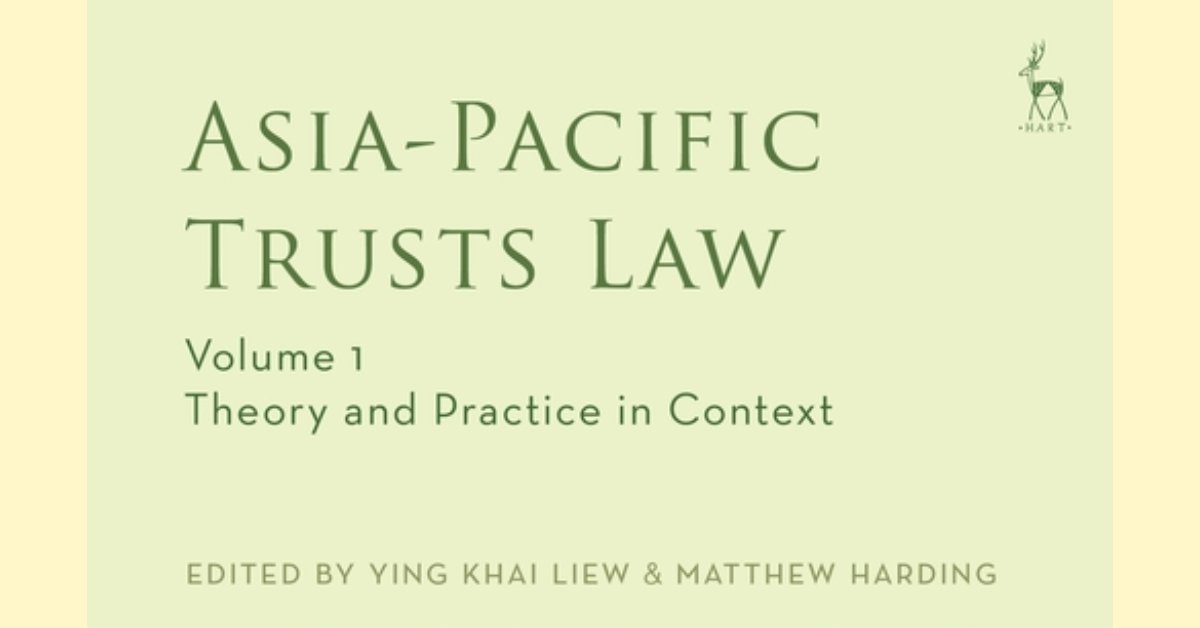
‘Asia-Pacific Trusts Law’ Book and Series Launch on 14 October 2021

You can sign up for this free Zoom event on Thursday 14 October 2021 for the launch of Asia-Pacific Trusts Law: Theory and Practice in Context.

Edited by Associate Professor Ying Khai Liew and Professor Matthew HardingAsia-Pacific Trusts Law: Theory and Practice in Context will be launched by Justice Andrew Phang (Supreme Court of Singapore) and Justice Susan Glazebrook (Supreme Court of New Zealand). Theory and Practice in Context is the first volume in the ‘Asia-Pacific Trusts Law’ book series.

This event is hosted by the Asian Law Centre and the Obligations Group at Melbourne Law School, The University of Melbourne and the Centre for Commercial Law in Asia at Singapore Management University.

You can also purchase the book online here.

Case Update: High Court Finds that Listed Companies Cannot Apply for Judicial Management

The High Court in the judicial management application of Re Scomi Group Bhd decided that public listed companies cannot apply for judicial management. Hence, Scomi Group Bhd’s judicial management application was dismissed.

I have updated this article with the full grounds of judgment dated 4 October 2021.

Continue reading